What Is a Lead Sheet?
A lead sheet is a one-page summary of a song. It shows the three things you need to perform it and leaves everything else to the musicians:
- Melody: written as a single line on a staff
- Harmony: written as chord symbols above the staff
- Lyrics: written as text under the notes
That is the whole idea. A lead sheet does not tell the pianist which voicing to play, the bassist which line to walk, or the drummer which groove to use. Players read the chord symbols and fill in the rest in their own style.
This makes lead sheets the standard way to share songs in jazz, pop, worship bands, session work and songwriting. A full piano and vocal arrangement of a song can run six pages. The lead sheet usually fits on one or two.
You may also hear lead sheets called fake sheets. A collection of them is a fake book, the most famous being the Real Book of jazz standards.
What's on a Lead Sheet
A typical lead sheet contains more than melody and chords. Here is everything you are likely to see, top to bottom:
| Element |
Where it sits |
What it tells you |
| Title and composer |
Top of the page |
The song and who wrote it |
| Style or tempo marking |
Top left |
The feel, e.g. "Medium Swing" or "Ballad, 72 BPM" |
| Key signature |
Start of each staff |
Which notes are sharp or flat throughout |
| Time signature |
Start of the first staff |
Beats per bar, usually 4/4 |
| Rehearsal marks |
Above the staff at section starts |
Section labels like A, B, Verse, Chorus |
| Chord symbols |
Above the staff |
The harmony to play under the melody |
| Melody |
On the staff |
The notes to sing or play |
| Lyrics |
Under the staff |
The words, lined up with the melody notes |
| Repeats, endings, codas |
On the staff and above it |
The order to play the sections in |
If you know how a song is built from sections, rehearsal marks will look familiar. They map directly onto the parts of a song: intro, verse, pre-chorus, chorus and bridge.
Lead Sheet Symbols: Every Chord Symbol Explained
Lead sheet symbols (also called chord symbols) are the shorthand that tells you which chord to play. Every symbol has up to three parts:
- Root: the letter name of the chord, e.g. C, F#, Bb
- Quality: major, minor, diminished, augmented or suspended
- Extensions and alterations: numbers like 7, 9, 11, 13, and changes like b5 or #9
If there is no quality marking, the chord is major. A plain C means C major.
The tricky part is that there is no single standard. The same chord can be written several ways depending on the publisher, the genre and the era. The table below lists the common spellings, all using C as the root.
Triads and basic chords
| Chord |
Common symbols |
Notes (root C) |
| Major |
C, CM, Cmaj |
C E G |
| Minor |
Cm, Cmin, C- |
C Eb G |
| Diminished |
Cdim, C° |
C Eb Gb |
| Augmented |
Caug, C+ |
C E G# |
| Suspended 4th |
Csus4, Csus |
C F G |
| Suspended 2nd |
Csus2 |
C D G |
| Power chord |
C5 |
C G |
| Added 9th |
Cadd9, Cadd2 |
C E G D |
| Major 6th |
C6 |
C E G A |
| Minor 6th |
Cm6, C-6 |
C Eb G A |
Seventh chords
| Chord |
Common symbols |
Notes (root C) |
| Dominant 7th |
C7 |
C E G Bb |
| Major 7th |
Cmaj7, CM7, CΔ7, CΔ |
C E G B |
| Minor 7th |
Cm7, Cmin7, C-7 |
C Eb G Bb |
| Half-diminished |
Cm7b5, Cø7, Cø |
C Eb Gb Bb |
| Diminished 7th |
Cdim7, C°7 |
C Eb Gb A |
| Minor major 7th |
Cm(maj7), C-Δ7 |
C Eb G B |
| Dominant 7th sus4 |
C7sus4, C7sus |
C F G Bb |
Extended and altered chords
Extensions stack more notes on top of the seventh chord. The number tells you the highest note added, and it usually implies the seventh underneath it.
| Chord |
Common symbols |
Notes (root C) |
| Dominant 9th |
C9 |
C E G Bb D |
| Major 9th |
Cmaj9, CΔ9 |
C E G B D |
| Minor 9th |
Cm9, C-9 |
C Eb G Bb D |
| Dominant 11th |
C11 |
C (E) G Bb D F |
| Dominant 13th |
C13 |
C E G Bb D A |
| Flat 9 |
C7b9 |
C E G Bb Db |
| Sharp 9 |
C7#9 |
C E G Bb D# |
| Sharp 11 |
C7#11 |
C E G Bb F# |
| Altered |
C7alt |
C E Bb plus any of b9, #9, #11, b13 |
On an 11th chord the 3rd is often left out, because it clashes with the 11th. That is why the E is in brackets.
If you are working out what notes a symbol contains, it helps to count intervals from the root. A minor 3rd is 3 semitones, a major 3rd is 4, a perfect 5th is 7. The Music Interval Calculator does this for any root and interval.
Slash chords
A slash chord puts a specific note in the bass. The chord comes before the slash and the bass note after it.
- C/E: a C major chord with E in the bass (first inversion)
- C/G: a C major chord with G in the bass (second inversion)
- C/Bb: a C major chord over a Bb bass note that is not in the chord
Slash chords are common in pop and gospel for smooth, stepwise bass lines, like C, C/B, Am, Am/G, F.
Other chord markings
| Marking |
Meaning |
| N.C. |
No chord: the band stops and the melody plays alone |
| % |
Repeat the previous bar |
| Chord in brackets, e.g. (G7) |
Optional chord, often a turnaround back to the top |
| Two chords in one bar |
Split the bar, usually two beats each in 4/4 |
Lead Sheet Notation: Reading the Roadmap
Chord symbols tell you what to play. The roadmap tells you in which order. A lead sheet saves space by writing each section once and using repeat signs and jumps to show how the song unfolds.
| Symbol |
Name |
What to do |
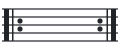 |
Repeat signs |
Play the bars between them twice |
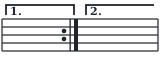 |
First and second endings |
Play the 1st ending the first time, skip to the 2nd ending on the repeat |
 |
Segno |
A landmark you jump back to |
 |
Coda sign |
A landmark for the ending section |
| D.C. |
Da Capo |
Go back to the very beginning |
| D.S. |
Dal Segno |
Go back to the segno sign |
| al Fine |
To the Fine |
After the jump, stop at the word Fine |
| al Coda |
To the Coda |
After the jump, play until "To Coda", then skip to the coda sign |
| Fine |
End |
The last bar of the song |
| / / / / |
Slash notation |
Keep time and play the chords; no melody written |
So D.S. al Coda means: go back to the segno, play until you see "To Coda", then jump to the coda section and play it to the end.
Slash notation is also how solo sections are written. The melody disappears, the chord symbols stay, and each slash marks a beat.
Lead Sheet vs Sheet Music vs Chord Chart
People mix these up constantly. Here is how they compare:
|
Lead sheet |
Full sheet music |
Chord chart |
Tab |
| Melody |
Yes, notated |
Yes, notated |
No |
Sometimes |
| Chords |
Symbols |
Written out note by note |
Symbols or numbers |
Fret positions |
| Lyrics |
Yes |
Yes |
Often |
Rarely |
| Accompaniment |
Improvised by players |
Fully written |
Improvised by players |
Written for one guitar part |
| Length |
1 to 2 pages |
Several pages |
1 page |
Varies |
| Needs notation reading |
Yes |
Yes |
No |
No |
| Best for |
Jazz, pop, singers, session players |
Exact performances, classical, piano and vocal books |
Rhythm section, worship bands |
Guitarists learning parts |
A chord chart is a lead sheet without the melody. It works when everyone already knows the tune. Some bands write chord charts using the Nashville Number System, where chords are numbers relative to the key (1, 4, 5) so the chart works in any key.
How to Read a Lead Sheet
A lead sheet looks sparse, but reading one is a skill. A simple approach:
- Check the key and time signature first. The key signature tells you which notes are sharp or flat, and it also tells you which chords to expect.
- Follow the roadmap before playing. Find the repeats, endings, D.S. and coda markings and trace the order of sections.
- Read the chord symbols as blocks. Know how many beats each chord lasts. One chord in a bar of 4/4 gets four beats.
- Play the melody on top. On piano, the right hand plays the melody and fills in chord tones underneath. The left hand plays roots or simple voicings.
- Keep the voicings simple at first. Root, 3rd and 7th are enough to make any seventh chord sound right. Add extensions once the song is under your fingers.
If a chord symbol looks unfamiliar, break it into root, quality and extension, then check it against the tables above.
Transposing a Lead Sheet
One of the biggest advantages of a lead sheet is how easy it is to change key. A singer who needs the song lower does not need a new arrangement, only new chord symbols and a moved melody.
To transpose:
- Pick the interval. Going from C to A is down a minor 3rd (3 semitones).
- Move every chord root by that interval. C becomes A, F becomes D, G7 becomes E7.
- Keep the quality and extensions the same. Cmaj7 becomes Amaj7, Dm7 becomes Bm7.
- Move the melody by the same interval and update the key signature.
Thinking in scale degrees makes this faster. In C major, the chords C, F and G are the 1, 4 and 5. In A major, the 1, 4 and 5 are A, D and E. Same progression, new key.
How to Make a Lead Sheet
There are three ways to make one, depending on what you start from.
By hand
Staff paper and a pencil still work. Write the melody first, add chord symbols above the exact beat each chord changes on, then add lyrics under the notes. Finish with rehearsal marks and the roadmap. Keep it to one or two pages; that is the point of a lead sheet.
In notation software
MuseScore (free), Dorico, Sibelius and Finale all have dedicated chord symbol input, and they automatically keep symbols aligned when you move notes. Most can also transpose the whole lead sheet in one click. Export to PDF for printing or sharing.
If you are writing an original song, you can start from the harmony. Generate a progression with the Random Chord Progression Generator, write a melody over it, then notate both.
From a recording
Transcribing a song by ear takes time, even for experienced musicians. First you find the key and tempo, then the chords bar by bar, then the melody note by note.
Recreate does that work for you. Upload a song, choose Lead Sheet (PDF) in the output dropdown, and you get a printable lead sheet with:
- The melody line on the staff
- Chord symbols above it
- The bass line underneath
- A key signature chosen from the notes of the song
The notes are tidied for reading: snapped to a grid, and short gaps held through instead of cluttering the page with rests. If you would rather edit the result, choose MusicXML instead and open it in MuseScore, Dorico, Sibelius or Finale.
Two things to keep in mind. First, Recreate does not write lyrics, so add those yourself in notation software or by hand. Second, expect to correct a few notes, especially on dense or heavily produced tracks. Starting from a draft that is mostly right is still much faster than starting from a blank staff.
If you only need the tempo and key before transcribing by hand, the BPM and Key Finder gives you both from an audio file.
Why Producers Should Care About Lead Sheets
Lead sheets are not only for jazz musicians. If you produce music in a DAW, they solve a few real problems:
- Hiring session players. A guitarist, pianist or horn section can walk in and play your song from a lead sheet without learning it from a demo first.
- Working with singers. A topline writer or vocalist gets the melody and chords on one page, in their key.
- Publishing and registering songs. A song as a composition is the melody, harmony and lyrics, which is exactly what a lead sheet documents. Publishers and co-writers still often ask for one.
- Covers and live sets. Turning a released track into a lead sheet is the fastest way to prepare a live band arrangement.
FAQ
What is the difference between a lead sheet and a fake book?
A lead sheet is a single song. A fake book is a collection of lead sheets bound together, usually hundreds of songs in one volume. The name comes from musicians "faking" the full arrangement from the melody and chords.
What does the triangle mean in lead sheet symbols?
The triangle (Δ) means major 7th. CΔ and CΔ7 both mean Cmaj7: C, E, G and B.
What does a circle with a slash mean on a lead sheet?
The circle with a slash (ø) means half-diminished, also written m7b5. Cø is C, Eb, Gb and Bb. A plain circle (°) means diminished.
What does a minus sign mean in a chord symbol?
A minus sign means minor. C-7 is the same as Cm7.
Do lead sheets include lyrics?
Usually, yes, when the song has words. Instrumental tunes like most jazz standards have lead sheets without lyrics.
Can I make a lead sheet from an audio file?
Yes. Recreate turns a recording into a lead sheet PDF with the melody, chord symbols and bass line, or into MusicXML you can edit in notation software. Lyrics are not included, and you should expect to fix a few notes.
Is a lead sheet the same as a chord chart?
No. A chord chart only shows chords and structure. A lead sheet also shows the melody in standard notation.
What key should a lead sheet be in?
The original key of the recording is the default. For singers, write it in the key they sing it in; a lead sheet is quick to transpose.